
.png)

Artificial intelligence is increasingly becoming part of the scavenger hunt app ecosystem. Instead of replacing game designers or event facilitators, most platforms are using AI to support the operational and creative aspects of running scavenger hunts.
While AI offers clear advantages for organizers and creators, it also introduces challenges related to accuracy, fairness, privacy, and game design quality. Understanding both sides is important for evaluating how these technologies shape modern scavenger hunt experiences.
This article explains what scavenger hunt apps are, using AI-powered features, how they use AI, what problems they aim to solve, and the benefits and risks associated with each approach.
Top Scavenger Hunt Apps with AI-Powered Features
PlayTours: AI for Validation and Moderation
PlayTours focuses its AI capabilities on validating player submissions and reducing the workload associated with moderating scavenger hunt events. Instead of generating entire hunts automatically, the platform applies AI to evaluate text responses, assess submitted photos, and assist organizers with writing or refining tasks.
AI Features
- AI-assisted task writing and rewriting
- AI-based text answer validation
- AI-based photo evaluation
- Smart image suggestions
Why It Is Useful for Organizers
For organizers and creators, this approach can be particularly useful when running large events. A scavenger hunt with hundreds of participants may generate thousands of submissions, including photos, written responses, and creative tasks. Reviewing each entry manually can require significant time and staff resources.
Another advantage is that creators can design more open-ended challenges. For example, participants might be asked to write a short poem, create a funny team photo, or describe something they discovered during the hunt. Without automated moderation tools, these types of tasks would be difficult to evaluate at scale.
Challenges and Limitations
However, this approach also presents challenges. AI systems may struggle to interpret creative submissions or unusual responses. Humor, sarcasm, or unexpected phrasing can lead to incorrect evaluations. If players feel that the system judged their submission unfairly, it may affect their overall experience. Because of this, AI moderation tools usually work best when combined with optional manual review.
Goosechase: AI for Mission Creation
Goosechase integrates AI primarily as a content-generation assistant. Its AI mission generator allows organizers to create scavenger hunt missions by entering prompts or themes. The system then produces a set of suggested tasks that can be edited and customized.
AI Feature
- AI Mission Generator
Why It Is Useful for Organizers
For organizers and creators, this tool significantly reduces the time required to design new hunts. Teachers, event planners, or team-building facilitators who may not have strong creative writing skills can quickly generate ideas for activities. For example, a teacher planning a campus orientation game could request “missions for new university students,” while a company organizing a team-building event might generate “creative office challenges.”
Challenges and Limitations
In practice, the AI functions more as a brainstorming assistant than a fully automated game designer. Organizers still need to review and refine the missions before launching the event. AI-generated tasks can sometimes feel generic or repetitive, and they may not always match the specific locations or cultural context of a particular event.
Social Scavenger: AI for Interactive Gameplay and Creative Challenges
Social Scavenger incorporates AI primarily to enhance player interaction and creativity during gameplay. Instead of focusing on automation or moderation, the platform uses AI in features such as photo transformations, interactive game characters, and AI-assisted challenges.
One example is AI-powered photo transformation. Players can upload photos during certain challenges, and the system can transform these images into stylized or themed visuals. This feature adds a playful and creative element to the scavenger hunt experience.
Another AI feature involves AI-powered characters or virtual guides that interact with players during story-based games. These characters can provide clues, respond to questions, or guide teams through narrative challenges.
AI Features
- AI Photo Transformations
- AI Game Characters (NPCs)
- AI Hint or Companion System
- AI Design Challenges
Why It Is Useful for Organizers
For organizers and creators, these features help make scavenger hunts more immersive and engaging. AI-driven storytelling elements allow creators to design narrative-based games where players interact with characters or receive contextual clues. This can transform a standard scavenger hunt into a more interactive experience similar to a role-playing or mystery-solving game.
The AI photo features also encourage players to participate more actively in creative challenges. Teams are often more motivated to produce unique photos or creative submissions when the results can be visually transformed or enhanced by AI.
Additionally, AI-assisted challenges can be used in workshops or corporate events where participants experiment with generative AI tools as part of the activity itself. This makes the platform useful not only for exploration-based hunts but also for learning or innovation-focused events.
Challenges and Limitations
While these features add creativity and interaction, they do not necessarily reduce operational workload in the same way that AI moderation or validation tools do. Organizers still need to design the overall game structure and review certain player submissions manually.
Another challenge involves ensuring that AI-generated responses or character interactions remain consistent with the story and game objectives. If the AI produces confusing or irrelevant responses, it could disrupt the narrative flow of the game.
There may also be privacy considerations when players upload photos or interact with AI-driven systems, especially in events involving large groups.
Scavos: AI for Hunt Generation
Scavos takes a broader approach by using AI to generate entire scavenger hunt structures. Its Adventure Assistant can produce hunt titles, mission descriptions, and story elements based on a simple prompt from the organizer.
AI Feature
- Adventure Assistant
Why It Is Useful for Organizers
For creators, this capability can dramatically reduce the time required to design a new hunt. Someone organizing an event can quickly generate a structured framework and then refine it to suit the location or audience. This is especially useful for organizers who frequently create new hunts or need to prepare events on short notice.
Challenges and Limitations
At the same time, fully automated content generation has limitations. AI-generated hunts may lack narrative depth or logical progression between missions. The system may also produce clues that do not align well with the physical environment where the hunt takes place.
Because of these limitations, AI-generated hunts typically serve as drafts rather than final products. Human editing is usually necessary to ensure the experience is engaging, coherent, and appropriate for the location.
Deckle: AI for Social Interaction
Deckle uses AI in a different way compared to most scavenger hunt platforms. Instead of focusing on exploration or task verification, the platform emphasizes social interaction and team dynamics.
One of its key features is smart team pairing. The system analyzes participant responses to simple questions and then automatically groups individuals into balanced teams. This helps prevent situations where participants form cliques or teams with uneven skill levels.
AI Features
- Smart Team Pairing (“Emoji Buddies”)
- AI-Generated Personal Trivia
Why It Is Useful for Organizers
Deckle also generates personalized trivia questions based on participant responses. These questions can be used as icebreaker activities during workshops or corporate events.
For organizers, these tools simplify the process of facilitating group interactions. Instead of manually organizing teams or designing icebreaker activities, the AI can handle these tasks automatically.
Challenges and Limitations
However, this approach depends on collecting participant data, which raises privacy considerations. Organizers must ensure that the information used to generate trivia or team assignments is handled responsibly. Additionally, algorithmic decisions about team composition may not always reflect real-world social dynamics.
Globe Chaser: AI for Personalized Routes and Adventure Creation
Globe Chaser integrates AI primarily through its intelligent editor and the AVA engine to support personalized scavenger hunt creation. These tools focus on route planning and quest generation to make outdoor exploration more dynamic and accessible.
The AI-powered editor allows users to enter preferences such as locations, themes, or activity types, for example family outings, sightseeing walks, or team-building adventures. Based on these inputs, the system automatically generates a route with quests and checkpoints.
The routes combine geocaching-style discovery with walkable navigation powered by the Google Maps API. This helps ensure that generated paths remain practical and safe for players to follow. Users can also modify the generated quests or routes instantly, allowing them to combine AI automation with manual adjustments.
In addition to the route designer, Globe Chaser includes the AVA AI assistant. AVA activates when there are no pre-built routes available in a user’s location. Using real-time GPS data, it can generate or suggest adventures dynamically based on nearby surroundings.
AI Features
- AI Route and Quest Designer
- AVA AI Assistant
Why It Is Useful for Organizers
For organizers and creators, these tools simplify the process of building location-based scavenger hunts. Instead of manually planning routes and checkpoints, the AI can generate a starting structure quickly. This makes it easier to create spontaneous hunts or explore new areas without extensive preparation.
The AVA assistant is particularly helpful for users who want to start an adventure immediately. It can analyze the surrounding environment and suggest nearby cultural landmarks, parks, or points of interest that can be turned into hunt challenges.
Challenges and Limitations
One limitation of this approach is that AI-generated routes may sometimes produce generic quests that require refinement to better match local context or storytelling goals.
The system also relies heavily on location data and GPS access. Without accurate location
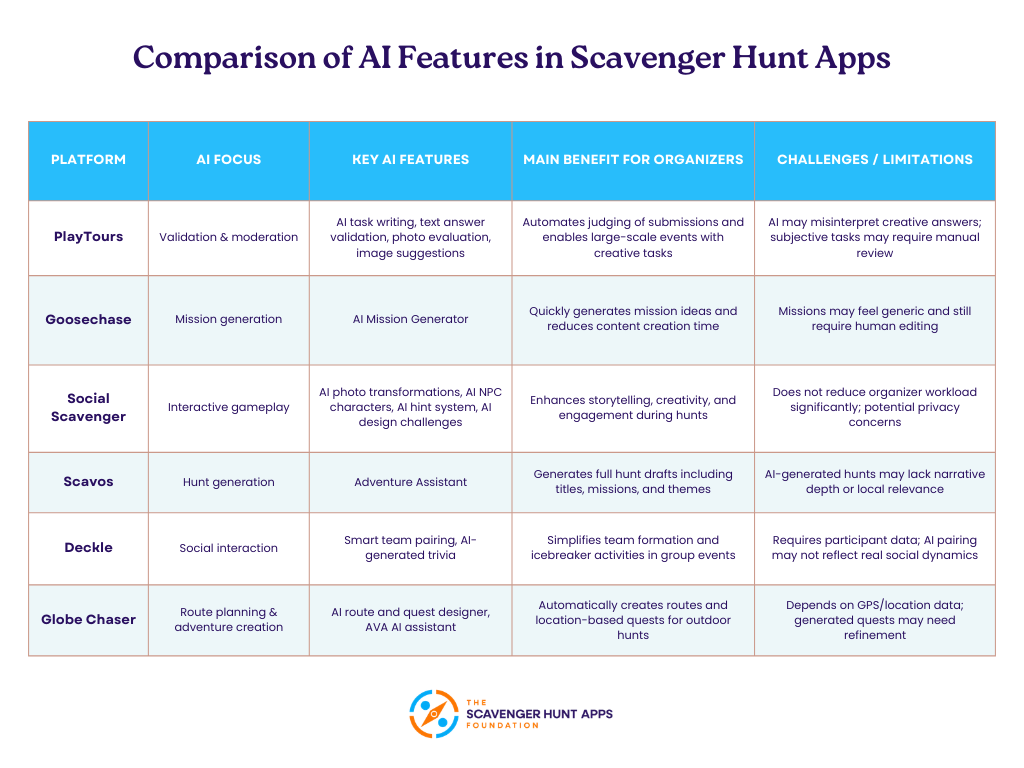
Overall Benefits for Organizers and Creators
Across these platforms, AI tools provide several clear advantages. They reduce the time required to create hunts, automate repetitive tasks such as moderation, and provide new insights into player behavior. For organizers managing large events, these capabilities can significantly reduce operational complexity.
AI also enables new types of gameplay. Creative challenges, personalized experiences, and dynamic event analytics would be difficult to implement without automated systems.
Key Risks and Challenges
Despite these advantages, AI-powered scavenger hunt platforms face several common challenges.
One of the most significant issues is reliability. AI systems can misinterpret images, text responses, or creative submissions. When these errors occur, players may feel that the game is unfair.
Over-automation is another concern. If organizers rely too heavily on AI-generated content, hunts may become repetitive or lack the creativity that makes them memorable.
Privacy and data protection also require attention. Many AI features analyze photos, location data, or participant behavior. Platforms must ensure that this information is collected and stored responsibly.
Finally, accessibility must be considered. AI-generated missions may unintentionally exclude participants with mobility limitations or other accessibility needs unless creators carefully review the content.
Conclusion
AI is becoming an important tool for scavenger hunt platforms, but it functions best as a support system rather than a replacement for human creativity. The most effective implementations combine automation with human oversight, allowing organizers to maintain control over the experience while benefiting from increased efficiency.
Ultimately, the goal of AI in this space is not simply to automate scavenger hunts. Instead, it is to help organizers and creators design richer, more scalable, and more engaging experiences for participants.


