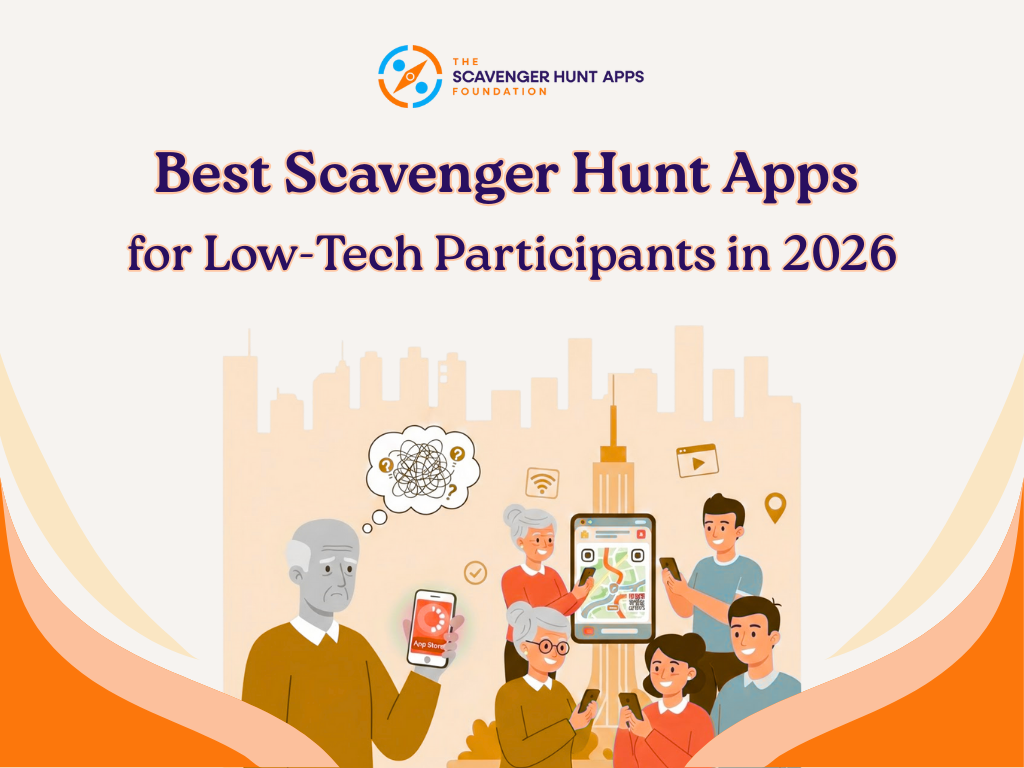

In event gamification, "low-tech" isn't just about age. It’s about patience. Whether you are dealing with a senior citizen who struggles to read small text or a busy executive who refuses to clutter their phone with another one-time-use app, the barrier is the same: friction.
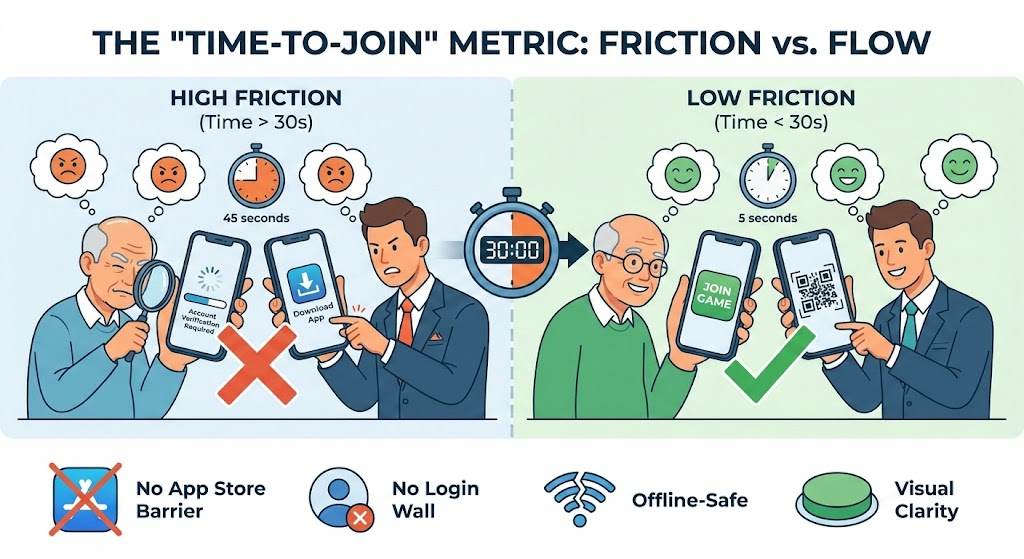
The "Time-to-Join" Metric
If a participant cannot join your game within 30 seconds of scanning the start code, you have already lost them. We call this the "Time-to-Join" metric.
We tested eight platforms, such as PlayTours, Scavify, Goosechase, Actionbound, Eventzee, Loquiz, TurfHunt, and Social Scavenger, specifically to see how they handle users who are not familiar with technology.
The Evaluation Framework
We ignored the bells and whistles (AR, image recognition, beacons) and focused on four failure points that kill momentum:
- The App Store Barrier: Does the user have to download anything? (Web vs. Native).
- The Login Wall: Do they need to verify an email address? (Guest Mode vs. Account).
- The "Loading..." Panic: What happens when the internet cuts out?
- Visual Clarity: Is the button big enough? Is the path linear?
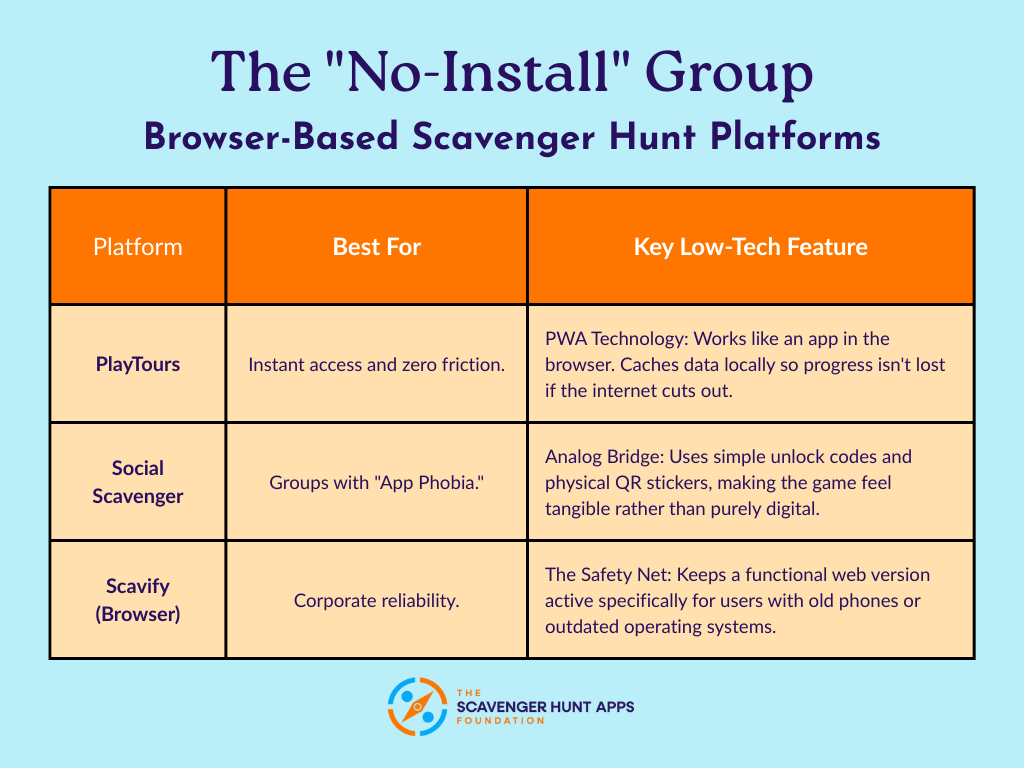
1. The "No-Install" Group (Browser-Based)
For one-off events, forcing a download is the biggest mistake you can make. These platforms run entirely in the mobile browser (Safari/Chrome).
PlayTours
Best for: Instant access and zero friction.
PlayTours is a Progressive Web App (PWA). That’s technical speak for "it works like an app, but lives in the browser." Participants scan a QR code and are immediately in the game.
It solves the connectivity issue by caching game data locally. If a player closes the browser or loses signal, their progress is saved to the cloud, and they can continue once they get back access.
Social Scavenger
Best for: Mixed groups with "App Phobia".
Social Scavenger understands that some people just won't download an app. They offer a native app for power users, but their mobile web player is a robust alternative. It uses "private unlock codes", a simple string of text, to let players in.
They also use physical markers well. Instead of relying solely on confusing GPS pins, you can print QR codes (stickers) for players to find. Finding a physical sticker is a tangible, analog activity that bridges the gap for non-tech users better than following a blue dot on a screen.
Scavify (Browser Option)
Best for: Corporate reliability.
Scavify is the reliable workhorse of the industry. While they push their native app for the best experience, they keep a functional browser version active. This is your safety net. If a participant shows up with a six-year-old Android phone that can't run the latest OS, you don't have to turn them away. You just send them the browser link.
2. The "No Account" Group (Native Apps)
Sometimes you need the power of a native app (better camera, smoother GPS). If you go this route, you must eliminate the "Create Account" step.
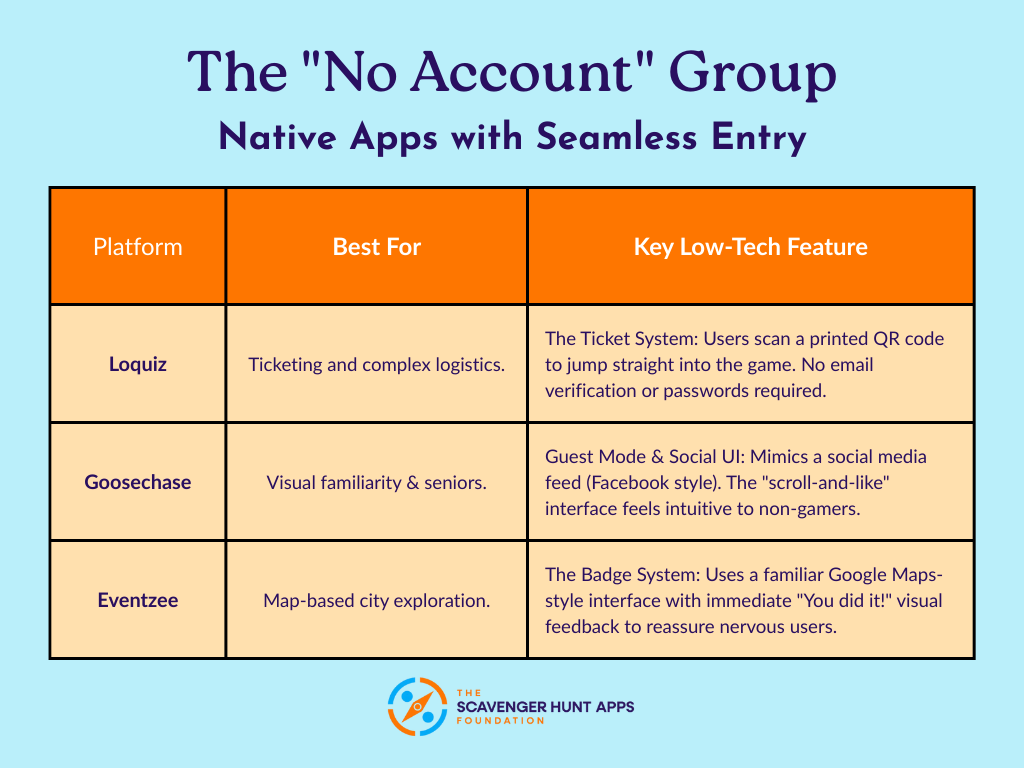
Loquiz
Best for: Ticketing and logistically complex events.
Loquiz has the most elegant login solution on the market: the Ticket System. You don't ask users to sign up. You hand them a printed QR code (or a specific username/password combo). They scan it, and the app starts.
Goosechase
Best for: Visual familiarity.
Goosechase is famous for its polished UI, but its "Guest Mode" is the real hero here. Players can join without an email address, saving data locally.
Visually, the app mimics a social media feed (Facebook or Instagram). Since many seniors are actually quite active on Facebook, this "scroll and like" interface feels familiar, not alien. It reduces the intimidation factor significantly.
Eventzee
Best for: Map-based exploration.
If your users can use Google Maps, they can use Eventzee. The interface (often branded as TownTrek for municipalities) is map-centric. Users see a pin, walk to it, and a task pops up.
The "Badge" system gives immediate, simple positive reinforcement. A big "You did it!" graphic goes a long way in reassuring a nervous user that they haven't broken anything.
3. The "Offline-Safe" Group
If you are in a nature park, a basement, or a rural town, the internet will fail. Web apps struggle here. You need native apps that download everything in advance.
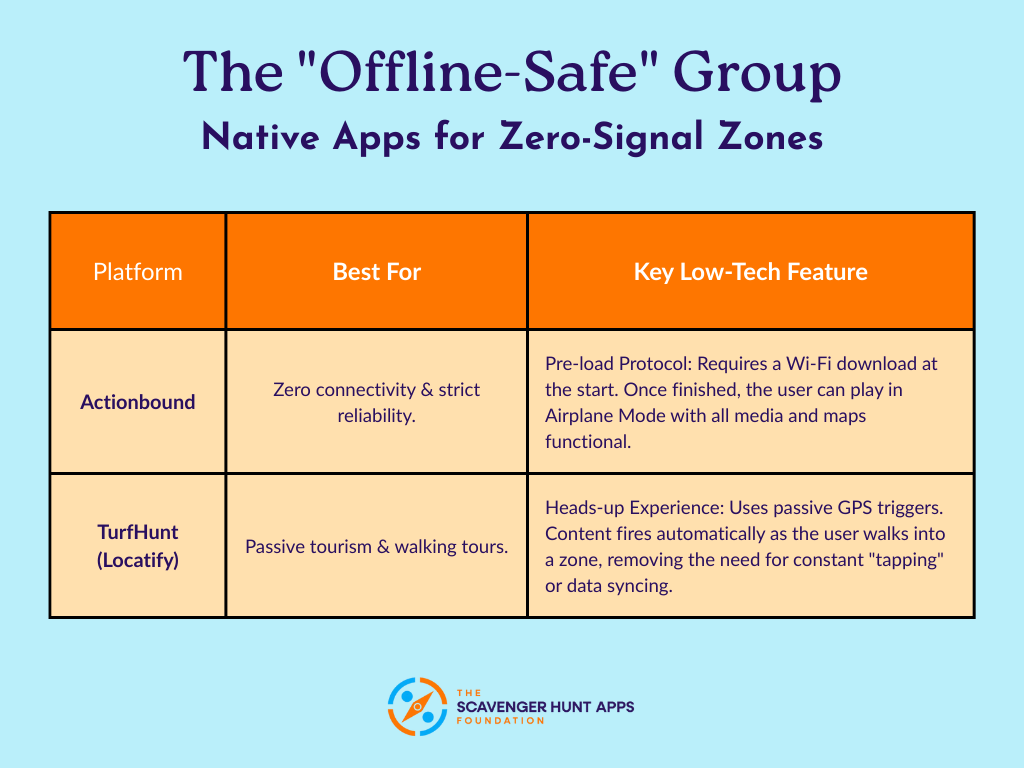
Actionbound
Best for: Zero connectivity environments.
Actionbound is the standard for offline reliability. It uses a strict "Pre-load" protocol. You keep your group on Wi-Fi at the start location until the entire game (audio, maps, videos) is downloaded.
Once that download finishes, they can switch to Airplane Mode. The game runs perfectly without a single byte of data. Results upload only when they return to Wi-Fi.
TurfHunt (Locatify)
Best for: Passive walking tours.
TurfHunt is designed for tourism. It uses "passive" GPS triggers. The user doesn't need to constantly tap buttons. They just walk. When they hit a zone, the content (audio or text) triggers automatically. This "heads-up" experience is much less demanding than active gaming apps and works fully offline once the map is downloaded.
Conclusion
There is no single "best" app. There is only the right tool for your specific friction point.
- If you have zero time: Use PlayTours. The link-to-play speed is unbeatable.
- If you have zero internet: Use Actionbound. It is the only way to guarantee the tech won't fail you in the woods.
- If you want to avoid "Sign Up" screens: Use Loquiz. The ticket system is seamless.
- If you want visual simplicity: Use Goosechase. It looks and feels like the apps your participants already use.


