

When choosing an app for a scavenger hunt, the pricing model is often as important as the feature list. In 2026, the market is split into two main categories: Per Player (paying for every participant) and Per Active Device (paying for concurrent connections).
Understanding the math behind these two models can save you thousands of dollars, especially for larger events.
To ensure the accuracy of this article, we conducted a comprehensive review of public pricing pages, help desk articles, and Terms of Service documents for over a dozen major scavenger hunt platforms as of January 2026. Data was cross-referenced with recent user reviews and third-party procurement comparisons to validate "Enterprise" quote estimates, which are often not publicly listed. We specifically focused on separating marketing claims (e.g., "unlimited players") from the actual technical limitations (e.g., "concurrent device caps") to provide a realistic Total Cost of Ownership.
The Two Models Explained
Per Player (The "Headcount" Model)
This is the traditional model used by many corporate and educational platforms. You pay a fee for every single person who joins the game.
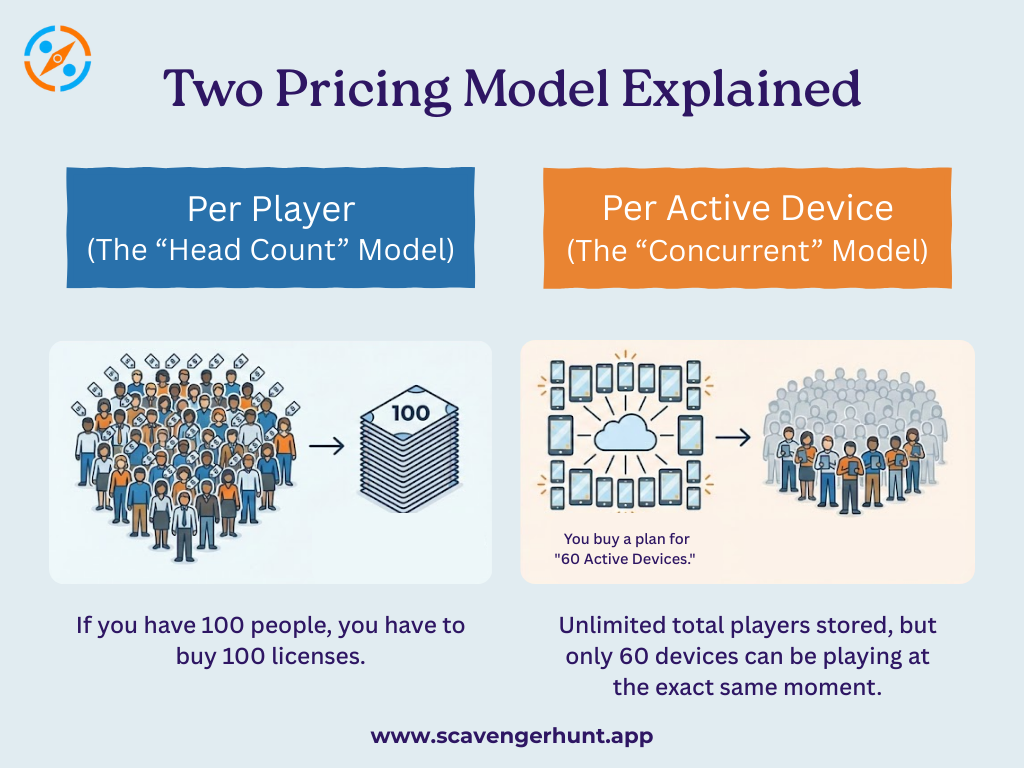
- How it works: If you have 100 people, you buy 100 licenses.
- The Cost: Pricing often scales with participant count, though vendors may offer bulk discounts for large enterprise contracts or educational districts.
Per Active Device (The "Concurrent" Model)
This model charges you based on capacity, not total headcount. You pay for the number of devices (phones/tablets) connected to the game at the same time.
- How it works: You buy a plan for "60 Active Devices." You can have unlimited total players stored in the system, but only 60 devices can be playing the game at the exact same moment.
- The Nuance: Even with per-device licensing, you can typically still create unlimited unique player profiles and usernames in the system.
Pros and Cons by Event Type
Which model works best depends entirely on your event size and frequency.
Per Player Pricing
Best for Small, one-off events; HR Onboarding; Exams/Assessments.
Pros
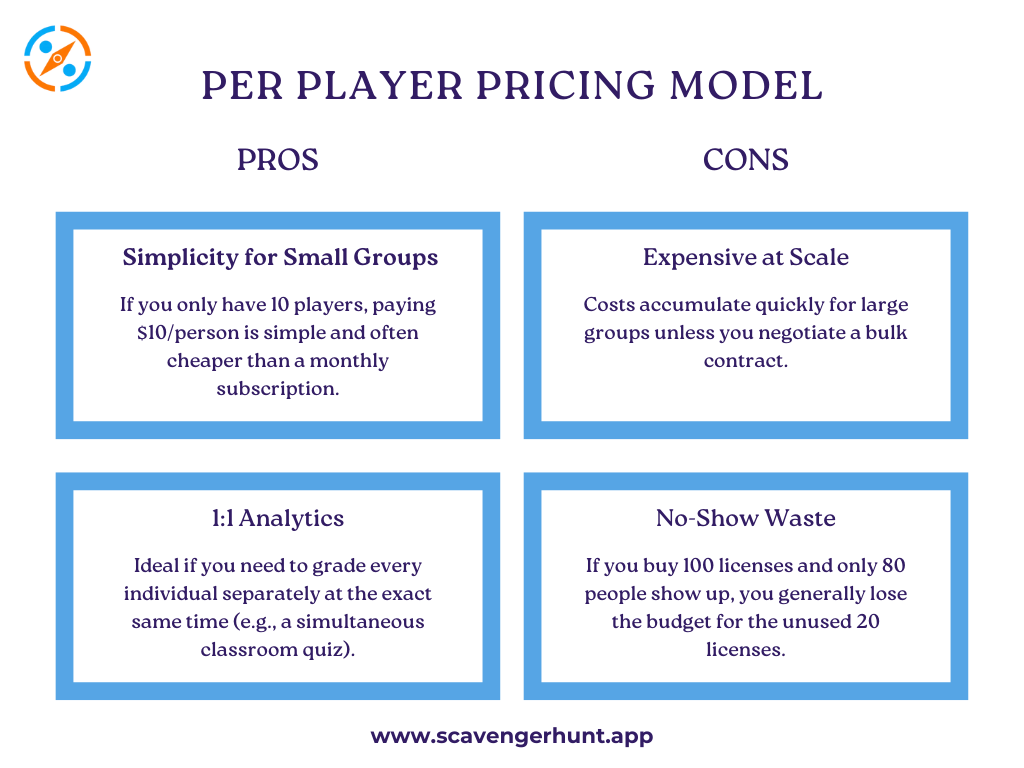
1. Simplicity for Small Groups
If you only have 10 players, paying $10/person is simple and often cheaper than a monthly subscription.
2. 1:1 Analytics
Ideal if you need to grade every individual separately at the exact same time (e.g., a simultaneous classroom quiz).
Cons
1. Expensive at Scale
Costs accumulate quickly for large groups unless you negotiate a bulk contract.
2. No-Show Waste
If you buy 100 licenses and only 80 people show up, you generally lose the budget for the unused 20 licenses.
Per Active Device Pricing
Best for Large events, Festivals, Multi-day Orientations, and team building.
Pros
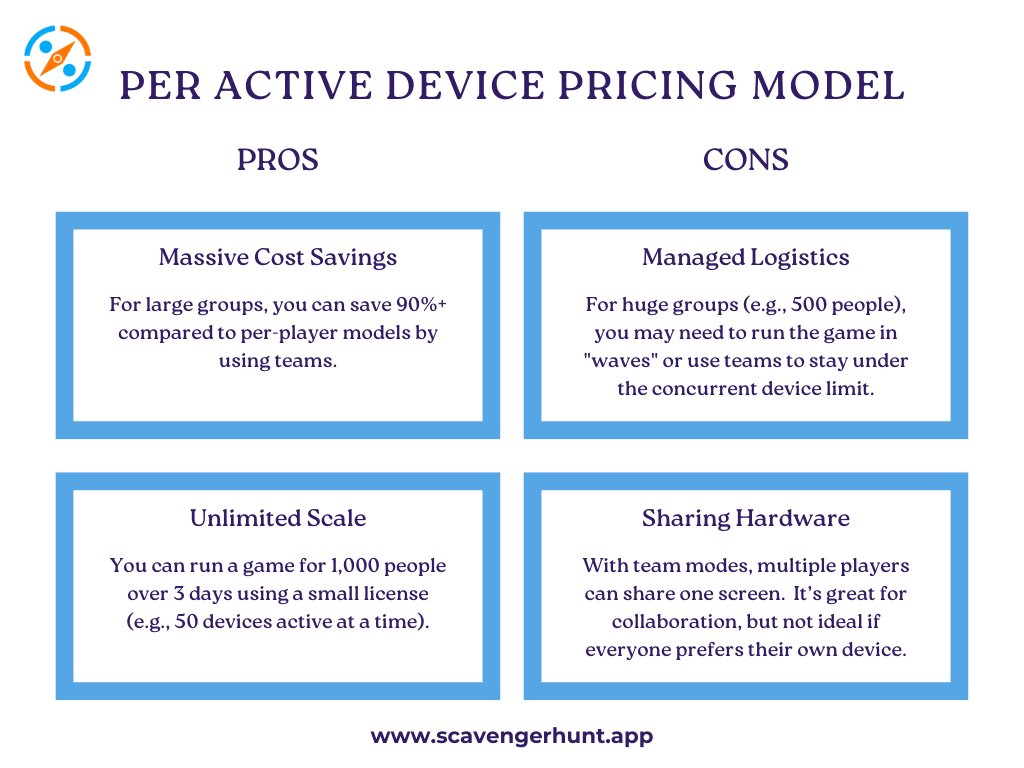
1. Massive Cost Savings
For large groups, you can save 90%+ compared to per-player models by using teams.
2. Unlimited Scale
You can run a game for 1,000 people over 3 days using a small license (e.g., 50 devices active at a time).
Cons
1. Managed Logistics
For huge groups (e.g., 500 people), you may need to run the game in "waves" or use teams to stay under the concurrent device limit.
2. Sharing Hardware/Devices
In team modes, 5 people share 1 screen. This is great for collaboration but less ideal if you want 5 people staring at 5 separate screens.
Scavenger Hunt App Pricing Comparison (January 2026)
The following table compares popular scavenger hunt app pricing as of January 2026. Note the difference between "Per Player" quotes and "Per Device" flat fees, especially at the 200-player mark.
Comparative Economics & ROI Analysis (The Math)
The difference in pricing models becomes obvious when we look at the math for three common scenarios.
Scenario A: The Company Team Building (100 People)
- Setup: 100 employees split into 20 teams (5 people per team).
- Goal: A one-hour event.
Scenario B: The University Orientation (1,000 Students)
- Setup: 1,000 students playing over 2 days.
- Goal: Campus tour. Students play in teams of 5 (200 teams total).
- Logistics: You stagger the start times so no more than 60 teams are playing at once (e.g., waves of 300 students every hour).
Because you can rotate students through the "Active Device" slots, the cost for PlayTours remains flat at $79. The per-player platforms charge you for every single student, resulting in a 6,000% price difference.
Scenario C: The Frequent Trainer (Weekly Events)
- Setup: A training agency runs a 20-person workshop every week for different clients.
- Total Annual Volume: 1,000+ different participants per year.
If you run frequent events, a "Per Active Device" subscription acts like a reusable venue rental. You rent the capacity once and fill it as many times as you want. A "Per Player" model acts like a ticket seller; you pay every time someone new walks through the door.


